Caranavi: where Bolivian coffee begins to find new paths
THE AYNI PROJECTOctober 10, 20264 min read
Some places are known through a cup. Others begin to make sense when you walk into their facilities, watch how the coffee is handled and talk to the people who make it possible.
Caranavi, in the Yungas of La Paz, is one of those places.
For THE AYNI PROJECT, getting to know an origin means going beyond the description of a product. It means getting closer to the people, understanding how the work is done, learning about the capabilities that exist on the ground and starting to identify what opportunities can emerge when a good coffee finds the right market.
During our visit to a coffee plant in Caranavi, that was exactly the aim: to start commercial relationships, see its infrastructure up close and explore possible green coffees that we could evaluate for future commercial opportunities.
What we found was a chance to look at Bolivian coffee from a wider perspective.
Caranavi: much more than a name on a bag of coffee
When we talk about origin coffee, we tend to think of a country, a region or a farm. But behind every origin there is a chain of knowledge, decisions and work that determines what happens from harvest until the coffee reaches the buyer.
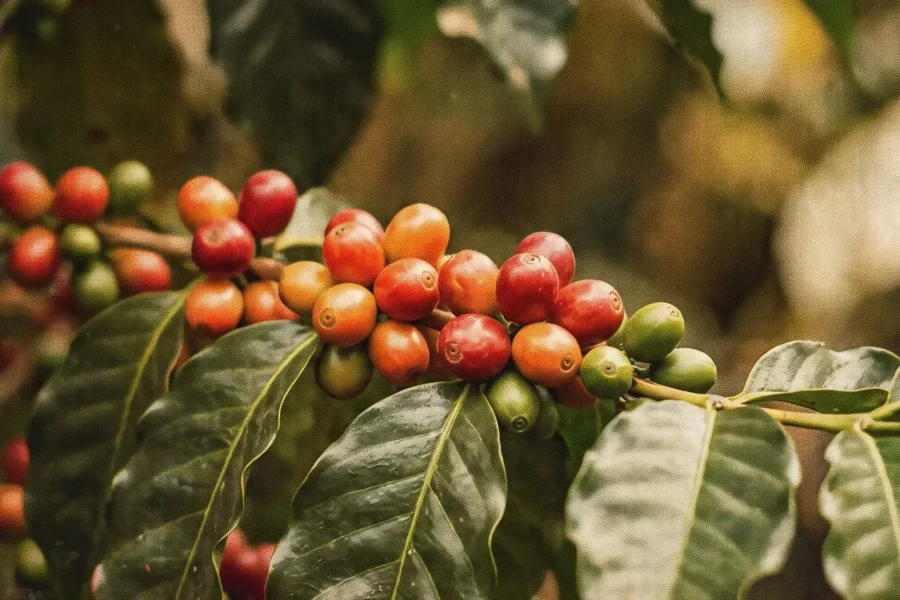
Caranavi is part of an important coffee-growing region of Bolivia. Its name comes up whenever we talk about the Yungas, about the producers who work in this area and about the possibilities of Bolivian coffee in national and international markets.
But the potential of an origin is not explained by its geography alone. It also depends on the people who work it, the processes they can develop, the consistency of the product and the ability to connect its quality with what a market expects.
That is why, for us, visiting Caranavi was not simply about finding an interesting coffee. We wanted to see the environment in which that coffee is prepared to continue its journey.
Inside a coffee plant: understanding what happens after harvest
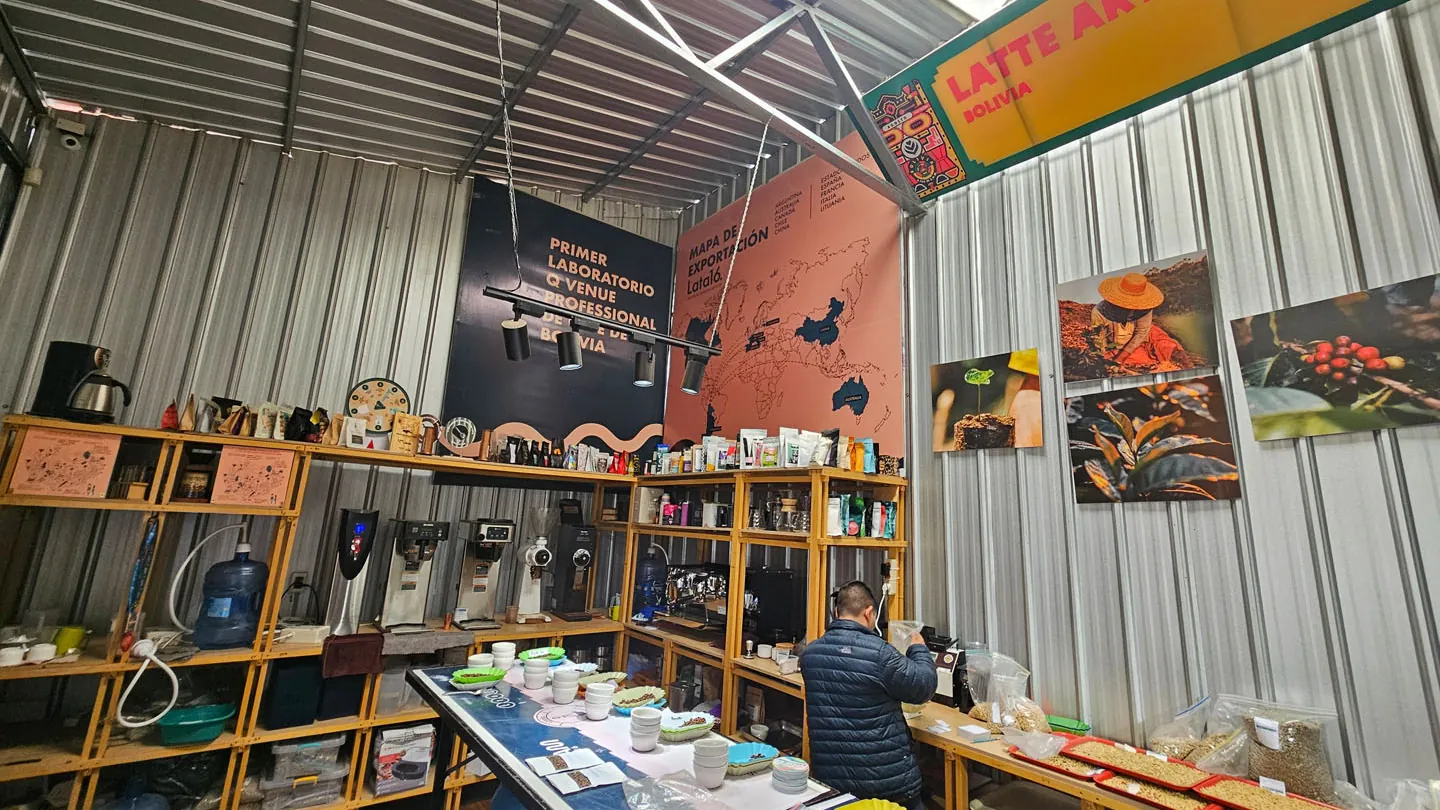
During our visit we were able to see different areas of the facility: the laboratory, the roastery, the warehouse and the work areas related to coffee.
Each of these spaces represents a different part of the story.
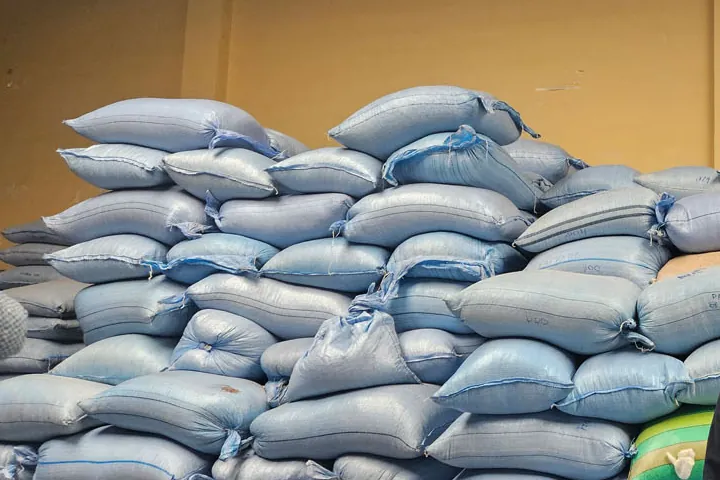
The laboratory offers a way into the analysis and evaluation of the product. The roastery helps explore how the coffee expresses itself in the cup. The warehouse reminds us of the importance of physically managing the product and of the conditions in which it is kept.
Seeing these areas up close helped us better understand the operational dimension of the project and open a conversation about possible collaborations.
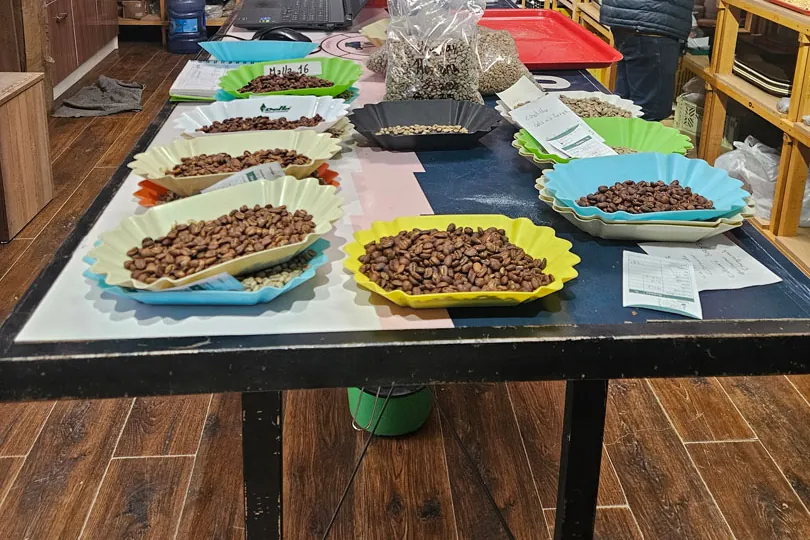
Cupping table in the laboratory, with trays of beans and cups.Warehouse area of the plant, with stacked sacks.
Photographs from our visit.
We also tasted some coffees. A cupping is always a starting point: it lets you explore profiles, ask questions and begin to understand what may be interesting for certain buyers.
It is not, on its own, a guarantee that a coffee suits every market. To reach that conclusion, further evaluation is needed.
Green coffee: the next step in our exploration
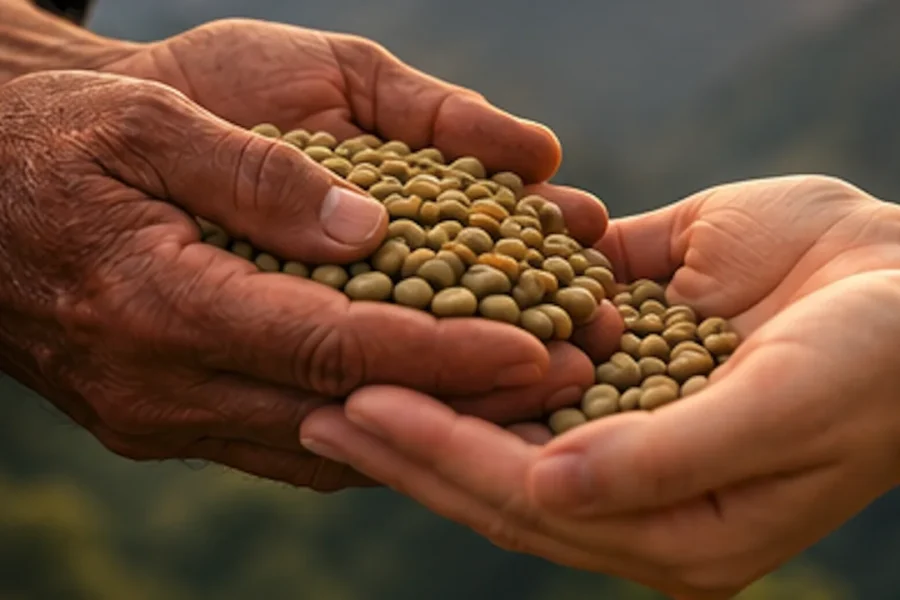
One of our main goals was to obtain green coffee samples so we could study them in more detail.
Those samples were still pending after our visit. We therefore cannot present this experience as a closed selection or attribute specific sensory profiles to the coffees we came across.
And that is precisely an important part of the way we work: curiosity does not replace analysis.
To evaluate a possible selection we need information about the lot, its origin, the variety when identified, the process, the harvest and the conditions of availability. After that, samples allow us to continue the technical and sensory evaluation, as we explain in our guide to choosing specialty green coffee.
Only then can we begin to assess whether a real commercial opportunity exists.
From Caranavi to the market: connecting origin and opportunity
The visit also made us reflect on the role that commercial relationships can play in the development of Bolivian coffee.
The newspaper El Fulgor published information about Lata 16 and its collaboration with Banco FIE, highlighting the promotion of Caranavi coffee and its international reach. The article mentions work with producers in the region, initiatives to support the sector and the presence of the coffee in different international markets.
This context helps show that an origin is not an isolated story: it is part of a productive activity that seeks to consolidate, reach new buyers and find opportunities to grow.
For those opportunities to become lasting relationships, the product, the available information, the buyer’s expectations and the commercial conditions have to fit together.
Our work starts by asking questions
At THE AYNI PROJECT we believe that discovering an interesting coffee is only the beginning.
We want to know the origins, understand the processes and study which products can connect with buyers’ needs. We are not trying to fill a catalogue. We are trying to build a selection with judgement.
Caranavi is part of that exploration. Our visit was a first commercial and technical approach, not the end of a negotiation or the confirmation of a selection.
The next step will be to continue the conversations, receive the pending samples and evaluate the opportunities with the information required.
Because behind a good coffee there is much more than a cup. There is an origin, knowledge and the possibility of building something together.
Do you work with Bolivian coffee, or are you looking for new origins for your business?
At THE AYNI PROJECT we are interested in connecting with producers, exporters, importers and roasters who share our curiosity about coffee and the value of long-term relationships.
A coffee can impress in a cupping and still not be the right one for a buyer. Origin, processing, traceability, sensory quality and commercial conditions: what is worth looking at.
Two coffees from the same region can surprise us in very different ways. Washed, natural and honey: what changes in processing and how to read it on a coffee sheet.
Give, receive and give back. The Andean principle of reciprocity that inspires the way we understand the coffee trade and connect producers, origins and markets.